

Overview
8x8 customers can set up call forwarding to enable your Recepta.ai voice agent to answer incoming calls. This guide walks you through the complete setup process, from obtaining your Recepta.ai phone number to configuring 8x8’s call forwarding rules.Getting Your Recepta.ai Phone Number
Before configuring 8x8, you’ll need to obtain your dedicated Recepta.ai phone number.Access Your Dashboard
Navigate to your Recepta.ai dashboard at https://recepta.ai/dashboard
Locate Your Phone Number
Your Recepta.ai phone number will be displayed prominently in the dashboard. Copy this number as you’ll need it for the 8x8 configuration.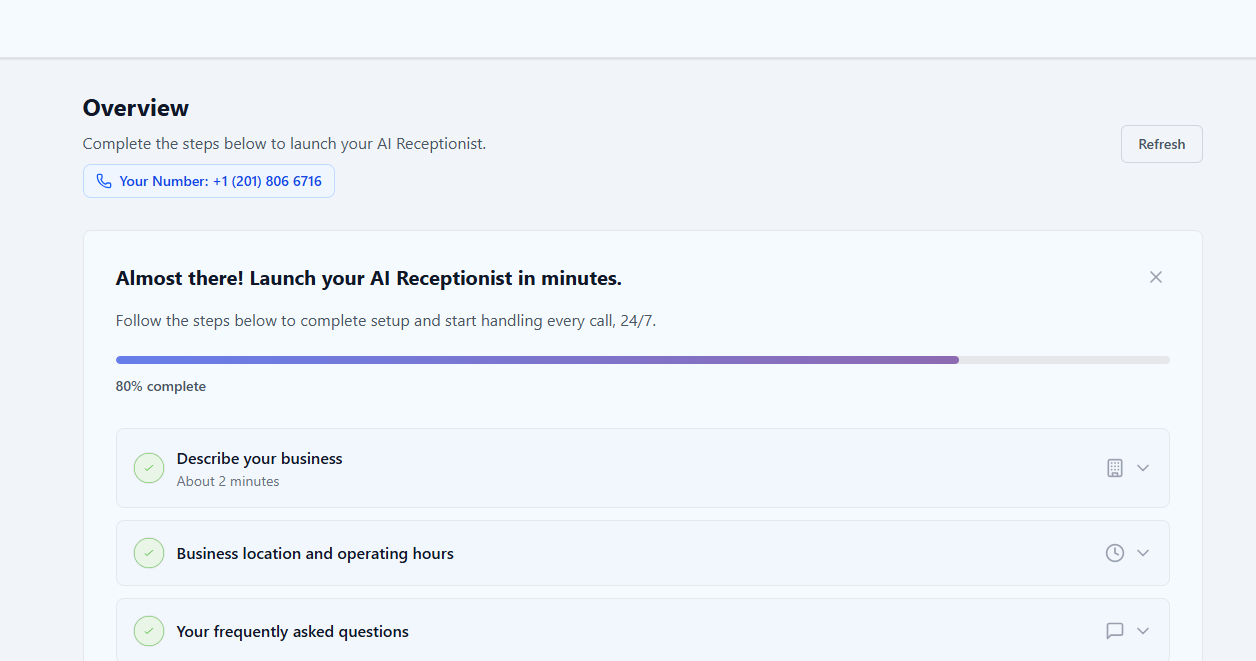
Keep your Recepta.ai phone number handy - you’ll need to enter it into 8x8’s forwarding settings.
Configuring Call Forwarding in 8x8
8x8’s interface may change over time. For the most current instructions, we recommend consulting 8x8’s official documentation. The general configuration process follows these steps:Setup Instructions
Enter Recepta.ai Number
In the Select target field, enter your Recepta.ai phone number. The system will recognize it as an external number.
Save Configuration
Save changes at both the rule level and the page level to ensure your settings are properly applied.
Call Forwarding Strategies
Choose the strategy that best fits your business needs:Direct Forwarding (24/7 AI Coverage)
Direct Forwarding (24/7 AI Coverage)
Best for: Businesses wanting complete AI automationSetup: Forward all calls directly to Recepta.ai phone numberBenefits:
- No missed calls
- Consistent service 24/7
- Reduced operational costs
- Instant call pickup
Sequential Routing (Team First, AI Backup)
Sequential Routing (Team First, AI Backup)
Best for: Businesses preferring human touch with AI backupSetup: Ring team for 5-10 seconds, then forward to Recepta.aiBenefits:
- Prioritize human interaction
- AI handles overflow and after-hours
- No calls go to voicemail
- Flexible coverage
Business Hours Based (Time-Sensitive Routing)
Business Hours Based (Time-Sensitive Routing)
Best for: Businesses with defined operating hoursSetup: Different routing for business hours vs after-hoursBenefits:
- Optimize for different times
- Cost-effective coverage
- Flexible scheduling
- Custom holiday routing
Important Configuration Tips
Ring Time Management
If you choose to ring your personal cell phone before falling back to Recepta.ai:- Maximum Ring Time: 5-8 seconds (10 seconds absolute maximum)
- Sequential Mode: Ensure phones ring one after another, not simultaneously
- Test Thoroughly: Make multiple test calls to verify timing
Preventing Infinite Call Loops
Safe Configuration Example:- Main 8x8 Number: Forwards to Recepta.ai → ✅ Correct
- AI Agent Transfer Destination: Your direct cell phone → ✅ Correct
- ❌ WRONG: AI transfers back to main 8x8 number (creates loop)
Advanced Configuration Options
Business Hours Routing
Configure different routing rules based on your business hours:During Business Hours
Route to your team first, then overflow to Recepta.ai for busy or unanswered calls
After Hours
Route all calls directly to Recepta.ai for 24/7 coverage
Holidays
Set special routing rules for holidays and special occasions
Peak Times
Use Recepta.ai during high-volume periods to ensure no calls are missed
Multi-Level Routing Strategy
For businesses that want a hybrid approach:Testing Your Configuration
Thorough testing ensures your setup works correctly in all scenarios:Troubleshooting
Calls Not Reaching Recepta.ai
Calls Not Reaching Recepta.ai
Diagnostic Steps:
- Verify correct Recepta.ai phone number is entered in 8x8
- Check that call forwarding rule is enabled and active
- Ensure your Recepta.ai agent is configured and active
- Review 8x8’s call flow settings
- Make test call and review logs in both systems
- Typo in Recepta.ai phone number
- Forwarding rule not saved properly
- Conflicting call handling rules
- AI agent not active
Calls Going to Voicemail
Calls Going to Voicemail
Solutions:
- Reduce ring time before forwarding (max 10 seconds)
- Ensure Recepta.ai is set as primary forwarding destination
- Disable or extend voicemail delay in 8x8 settings
- Check that forwarding rule takes precedence over voicemail
Infinite Call Loops
Infinite Call Loops
Solutions:
- Use different phone numbers for transfers
- Never forward 8x8 number to itself
- Configure AI transfers to direct lines (cell/desk phones)
- Review complete call flow logic
- Document your routing to avoid loops
Call Quality Issues
Call Quality Issues
Solutions:
- Verify stable internet connection
- Check 8x8’s system status page
- Review call logs in both 8x8 and Recepta.ai dashboards
- Contact Recepta.ai support if issues persist
- Test from different phone numbers/locations
Monitoring and Analytics
Tracking Performance
8x8 Analytics
Monitor call volume, routing patterns, and forwarding statistics
Recepta.ai Dashboard
Track AI performance, conversation quality, and outcomes
Call Logs
Review detailed logs from both systems to identify issues
Quality Metrics
Measure customer satisfaction and agent performance
Key Metrics to Monitor
- Call Answer Rate: Percentage of calls successfully handled
- Average Wait Time: Time before AI picks up
- Transfer Rate: How often AI transfers to humans
- Call Duration: Length of AI conversations
- Customer Satisfaction: Ratings and feedback
- Cost Savings: Compare to previous solution
Best Practices
Minimize Wait Time
Keep ring times under 10 seconds to reduce caller drop-off
Test Regularly
Test your setup monthly to catch configuration changes
Configure Holidays
Set up special routing for holidays and special events
Monitor Analytics
Review performance weekly to identify issues early
Update AI Knowledge
Keep your AI agent’s knowledge base current
Document Setup
Keep records of your configuration for troubleshooting
Next Steps
After configuring call forwarding:Configure Your Agent
Customize your AI agent’s responses and behavior
Set Up Transfers
Configure call transfer destinations and rules
Add Knowledge Base
Train your AI agent with company-specific information
View Analytics
Monitor performance and optimize call handling
Need Help?
Email Support
Contact our support team at support@recepta.ai
8x8 Support
Visit 8x8’s support for platform-specific questions
Schedule Demo
Book a personalized walkthrough with our team
Documentation
Browse our comprehensive documentation